Agricultural Development Services
The agricultural sector has been identified in the Constitution of the Republic of South Africa (1996) and a number of the frameworks as a sector, can contribute meaningfully to job creation.
1. PROBLEM STATEMENT
South Africa’s low economic growth and investments have had a severe impact on poverty and unemployment and has increased inequality, as follows:
- Unemployment in the era of educated youth and the 4th Industrial Revolution (4IR): A total of 21 0931 [4596 in agriculture] graduates are produced by higher learning institutions per annum; however, 27% of the labour force remains unemployed. Amongst youth, over 50% is unemployed
- Food and Nutrition insecurity is rife and 40% of the population lives within the poverty line
- Poverty is more acute amongst women [42%] than men [38%],and more devastating in rural areas [65.4%]
- The agricultural economy is exclusive and dualistic:
- ±35 000 commercial farmers produce the majority of South Africa’s agricultural output
- 66% of South Africa’s water is used by agriculture and 98% of water rights is with white farmers
- The World Bank indicates that South Africa is amongst the most unequal societies in the world
- Unemployment and limited access to South Africa’s resources by majority of its people is the primary cause of inequality
- ±35 000 commercial farmers produce the majority of South Africa’s agricultural output
1.1 Programme Objectives:
- To provide support to producers through agricultural development programmes.
- To enable and support transformation of the agriculture sector to actively contribute to economic growth, inclusion, equality and the creation of decent work.
- To increase food production through producer support and development initiatives
1.2 Sub-Programmes:
- Sub-Programme 1: Producer Support Services
- Sub-Programme 2: Extension and Advisory Services
- Sub-Programme 3: Food Security
|
Sub Programme |
Intervention Programme |
|
Producer Support |
Comprehensive Agriculture support programme |
|
Departmental infrastructure programmes |
|
|
Extension & Advisory Services |
Extension Recovery Plan |
|
Food Security |
Communal investment |
|
Household seed distribution programme |
|
|
Blended Mechanization programme |
2. LEGISLATIVE MANDATE AND POLICIES
Public Finance Management Act (PFMA)
Division of Revenue Act (DORA)
Transfer Payment Policy 2016
Agriculture & Agro-processing Master Plan (2023)
National Policy on Food & Nutrition Security (2014)
KwaZulu-Natal Agricultural Development Policy (2020)
National Policy on Comprehensive Producer Development Support (NPCPDS):
Norms and Standards for Extension and Advisory Services (2005):
District Development Model (One Plan)
New Growth Path (NGP, 2010), the
National Development Plan (Vision 2030, 2012)
National Policy on Extension and Advisory Services (October 2016)
Strategy for Employment of Young Agricultural Graduates in Extension and Advisory Services (April 2016)
3. AGRICULTURAL POTENTIAL
|
District Municipality / Metro |
Traditional Council Area (ha) |
Area potentially arable in Traditional Council (Ha) |
|
AMAJUBA |
51 288.81 |
4 023.00 |
|
ETHEKWINI |
86 859.06 |
3 669.72 |
|
ILEMBE |
198 917.27 |
13 206.76 |
|
HARRY GWALA |
342 986.79 |
67 406.08 |
|
UGU |
236 154.90 |
5 474.40 |
|
UMGUNGUNDLOVU |
104 235.34 |
12 617.04 |
|
UMKHANYAKUDE |
631 518.67 |
4 397.44 |
|
UMZINYATHI |
364 921.92 |
11 630.44 |
|
UTHUKELA |
203 601.07 |
35 051.24 |
|
KING CETSHWAYO |
529 129.17 |
50 387.64 |
|
ZULULAND |
498 791.19 |
7 174.40 |
|
Grand Total |
3 248 404.19 |
211 015.16 |
4. LAND SUITABILITY:
|
Commodity |
|
|
Agronomy |
Maize Soyabeans Dry beans Sugarcane |
|
Horticulture |
Vegetables Potatoes Hazelnuts Berries Peaches |
|
Livestock |
Beef Sheep & wool Dairy Piggery Goat Poultry |
5. FARMER SUPPORT SERVICE:
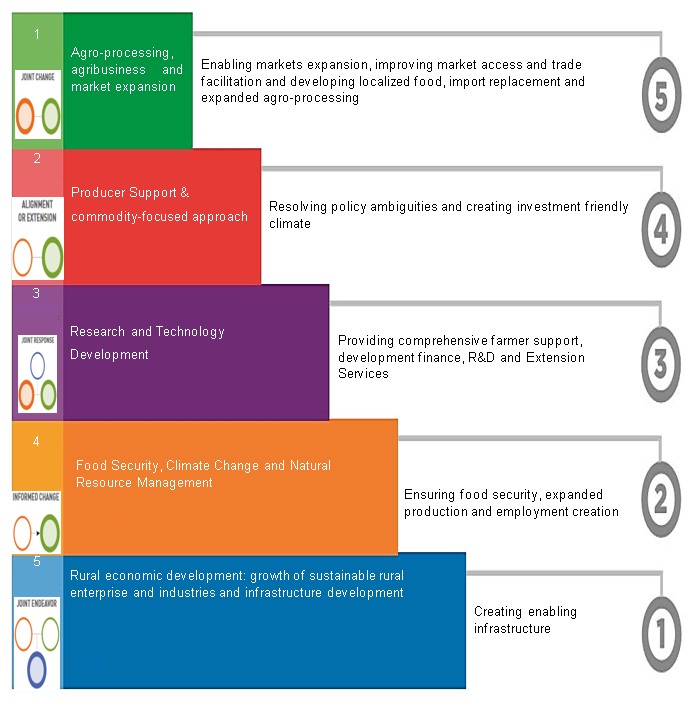
Aligned to the National Agricultural-Agro Master plan
5.1 MULTI-PLANTING SEASON
5.1.1 Government Tractors Support
- Divers procured for all districts
- Each district is allocated 5 tractors with 6 tractor drivers (total 45 tractors in 10 districts)
- 6 artisan employed to be based in Cedara and Makhathini
- Focus on areas with 1-5ha
- Programme to be controlled centrally
5.1.2 Service Provider
- One Service Provider per local municipality.
- Local Manager to supervise the work done.
- Internal Control to verify work prior to payment.
- The farmer must not have access to alternative mechanisation equipment
- Service provider to be given maximum of 500 ha
- Focus on areas with 0,5 -1ha
- Operations to be done based on specification.
- Subcontracting will not be allowed
5.2 COMMUNITY INVESTMENT
|
No. |
Description |
Commodity Supported |
|
1 |
Provision of fencing material |
Livestock & crops |
|
2 |
Construction of boreholes |
Livestock & crops |
|
3 |
Construction of dip tanks |
Livestock |
|
4 |
Dip tank material & clamps |
Livestock |
|
5 |
Dam scooping |
Livestock |
6. EXTENSION & ADVISORY SERVICES
6.1 DEFINITION
According to Maunder (1978), Agricultural Extension can be defined as a service which assist farmers educationally to improve their farming methods and techniques through an increase in production efficiency with a view of improving their living standards and that of the community through extending research findings to them using desirable channels of communication, that is, improving teaching methodologies. “To help farmers to help themselves”
6.2 IMPORTANCE AND ROLES OF EXTENSION AND ADVISORY SERVICES
Extension is an integral component in ensuring efficient service delivery of government programmes aimed at alleviating poverty, improving livelihoods and a sustained environment.
National Framework for Extension Recovery Plan (DAFF, 2011) states that, with the increasing number of government programmes aiming at rural development, food security, land reform, (restitution and redistribution) and natural resources management, there is a growing need for dedicated professionals to support these programs.
Extension and Advisory Service has a measure role to play in agricultural development. Some of the roles are listed below:
- To assist producers, make efficient, productive, and sustainable use of their land and other agrarian resources, through the provision of information, advice, education and training.
- Contribute to accelerate technological, social and economic development
- Assisting producers to identify, production, enterprise and marketing challenges
- Empower and build capacity of producers, producer organizations and commodity groups to ultimately become self-reliant for improved living standards
- Provide information to research institutions on producer’s production constraints so that basic applied or adaptive research can be conducted etc.
6.3 OBJECTIVES
- To ensure effective linkage and exchange of information between research, extension and producers
- to establish a professional, accessible, reliable, relevant and accountable national extension service that is result oriented
- To ensure pluralistic and coordinated approach for the provision of extension and advisory services
6.4 CORE PRINCIPLES
- Poverty eradication
- Equity
- Prioritising production and income opportunities
- Promote sustainability
6.5 EXTENSION & ADVISORY SERVICES APPROACH
- Repositioning Agricultural Extension as a Strategic Sub-Field of Agriculture. Implementation of Presidential pronouncement of Extension personnel recruitment.
- Comprehensive Community Needs Assessment Through Participatory Approaches.
- Focusing on Study Groups, assisting farmers according to commodities.
- Strengthening Agricultural Education and On-Farm Demonstrations.
- Promoting Quality Production Through Agricultural Shows
- Smallholder Empowerment Programme (SHEP) approach - market-oriented agriculture ‘grow to sell’
6.6 EXTENSION AND ADVISORY SERVICES (EAS) DIRECTORATE:
6.6.1 Purpose:
- To provide a coordination and support service to Districts on Extension & Advisory services, extension tools and interventions.
- The Directorate is further responsible for the coordination of Livestock and Crops programmes.
- EAS divided into 2 sub-directorates, i.e. Extension Methodology and Agricultural Interventions
6.6.2 Extension Methodology:
• Extension Recovery Programme (ERP) –
- Improve Visibility and Accountability
- Improve Image and professionalism of Extension
- Recruitment
- Re-skilling &re-orientation
- Provision of ICT support tools, Co-ordination of Skills
• Extension Venture Agreement (EVA)
• Smallholder Empowerment Promotion (SHEP)
• Provincial Extension Coordinating Forum (PECF)
• Producer Farmer register (PFR)
- Registration to professional bodies (SACNASP)
6.6.3 Agricultural Interventions:
• Livestock programme: Kaonafatso ya Dikgomo
• Food and Nutrition Security programme
6.6.4 Annual Departmental Events:
• Launch of Provincial Planting Season,
• Provincial Extension Summit, Conferences & Seminars
• Provincial World Food Day
7. FOOD SECURITY:
7.1 Household Food Production:
Food and nutrition security is one of the fundamental strategic imperatives of the government of South Africa. The right to access sufficient food is firmly entrenched in the Constitution of the Republic of South Africa.
Inadequate and severely inadequate food access has been increasing over the years in the KwaZulu Natal province, indicating that more and more households are losing their constitutional right to sufficient food as outlined in the South African Constitution under Section (27)(b).
According to the 2023 HSRC report the access to agricultural extensions services has been reported to be extremely low in the entire KwaZulu-Natal. This can is attributed to the high vacancy rate.
HSRC report (2023) also shows that Zululand, Umzinyathi, Harry Gwala and uMhanyakude are leading in number of people who are food insecure.
KZN is amongst the provinces with the highest number of households with inadequate access to food. According to the 2025 GHS households that have inadequate access to food increased form 12,7 % in 2021 to 15,5 % in 2024, although it shows regression if compared with 2023.
7.2 Response to food insecurity and nutrition, formulated interventions include:
- Household Gardens
- Community Gardens
- Institutional Gardens (Clinics, Crèches, Schools & Churches)
- Mushrooms
|
Strategic Repositioning |
||
|
Programme |
Current Focus |
Strategic FNS Positioning |
|
Household Food Security |
Input support |
Nutrition-sensitive graduation pathway |
|
Township Agriculture |
Urban production |
Urban food access & job creation |
|
Seed Multiplication |
Production support |
Provincial food sovereignty strategy |
|
Mushroom Programme |
Enterprise support |
High-protein nutrition intervention |
|
Multi-Planting |
Seasonal production |
Climate resilience & stability pillar |
8. RISK AND MITIGATION
|
Outcome |
Key Risk |
Risk Mitigation |
|
|
To reduce household food insecurity in the province |
Insufficient allocation of budget |
Create awareness to farmers in taking responsibility for some activities that can’t be funded by DARD |
|
|
Climate Change |
Implementation of Early Warning system |
||
|
Promote the use of drought resistant varieties |
|||
|
Climate smart agriculture including promotion of conservation agriculture |
|||
|
Poor performance of service providers |
Appointment of panel of Service providers with credible history |
||
|
Improved farmer development for increased agricultural production and sector growth |
|||
|
Delay of procurement |
Advance planning and procurement of services Make use of Standing Contracts |
||
|
Change of use of agricultural land (competing with other developments) |
Classification of agricultural land and zoning |
EXTENSION & ADVISORY SERVICES CONTACT DETAILS
Mr N.L. Ntshangase
Tel No. 033 343 8133
E-mail: Njabulo.Ntshangase@kzndard.gov.za
The agricultural sector has been identified in the Constitution of the Republic of South Africa (1996), the and a number of the frameworks as a sector that can contribute meaningfully to job creation.
1. PROBLEM STATEMENT
South Africa’s low economic growth and investments have had a severe impact on poverty and unemployment and has increased inequality, as follows:
- Unemployment in the era of educated youth and the 4th Industrial Revolution (4IR): A total of 21 0931 [4596 in agriculture] graduates are produced by higher learning institutions per annum; however, 27% of the labour force remains unemployed. Amongst youth, over 50% is unemployed
- Food and Nutrition insecurity is rife and 40% of the population lives within the poverty line
- Poverty is more acute amongst women [42%] than men [38%],and more devastating in rural areas [65.4%]
- The agricultural economy is exclusive and dualistic:
ü ±35 000 commercial farmers produce the majority of South Africa’s agricultural output
ü 66% of South Africa’s water is used by agriculture and 98% of water rights is with white farmers
ü The World Bank indicates that South Africa is amongst the most unequal societies in the world
ü Unemployment and limited access to South Africa’s resources by majority of its people is the primary cause of inequality
1.1. Programme Objectives:
· To provide support to producers through agricultural development programmes.
· To enable and support transformation of the agriculture sector to actively contribute to economic growth, inclusion, equality and the creation of decent work.
· To increase food production through producer support and development initiatives
1.2. Sub-Programmes:
- Sub-Programme 1: Producer Support Services
- Sub-Programme 2: Extension and Advisory Services
- Sub-Programme 3: Food Security
|
Sub Programme |
Intervention Programme |
|
Producer Support |
Comprehensive Agriculture support programme |
|
Departmental infrastructure programmes |
|
|
Extension & Advisory Services |
Extension Recovery Plan |
|
Food Security |
Communal investment |
|
Household seed distribution programme |
|
|
Blended Mechanization programme |
2. LEGISLATIVE MANDATE AND POLICIES
Public Finance Management Act (PFMA)
Division of Revenue Act (DORA)
Transfer Payment Policy 2016
Agriculture & Agro-processing Master Plan (2023)
National Policy on Food & Nutrition Security (2014)
KwaZulu-Natal Agricultural Development Policy (2020)
National Policy on Comprehensive Producer Development Support (NPCPDS):
Norms and Standards for Extension and Advisory Services (2005):
District Development Model (One Plan)
New Growth Path (NGP, 2010), the
National Development Plan (Vision 2030, 2012)
National Policy on Extension and Advisory Services (October 2016)
Strategy for Employment of Young Agricultural Graduates in Extension and Advisory Services (April 2016)
3. AGRICULTURAL POTENTIAL
|
District Municipality / Metro |
Traditional Council Area (ha) |
Area potentially arable in Traditional Council (Ha) |
|
AMAJUBA |
51 288.81 |
4 023.00 |
|
ETHEKWINI |
86 859.06 |
3 669.72 |
|
ILEMBE |
198 917.27 |
13 206.76 |
|
HARRY GWALA |
342 986.79 |
67 406.08 |
|
UGU |
236 154.90 |
5 474.40 |
|
UMGUNGUNDLOVU |
104 235.34 |
12 617.04 |
|
UMKHANYAKUDE |
631 518.67 |
4 397.44 |
|
UMZINYATHI |
364 921.92 |
11 630.44 |
|
UTHUKELA |
203 601.07 |
35 051.24 |
|
KING CETSHWAYO |
529 129.17 |
50 387.64 |
|
ZULULAND |
498 791.19 |
7 174.40 |
|
Grand Total |
3 248 404.19 |
211 015.16 |
4. LAND SUITABILITY:
|
Commodity |
|
|
Agronomy |
• Maize • Soyabeans • Dry beans • Sugarcane |
|
Horticulture |
• Vegetables • Potatoes • Hazelnuts • Berries • Peaches |
|
Livestock |
• Beef • Sheep & wool • Dairy • Piggery • Goat • Poultry |
5. FARMER SUPPORT SERVICE:
Aligned to the National Agricultural- Agro Master plan

5.1. MULTI-PLANTING SEASON
5.1.1. Government Tractors Support
- Divers procured for all districts
- Each district is allocated 5 tractors with 6 tractor drivers (total 45 tractors in 10 districts)
- 6 artisan employed to be based in Cedara and Makhathini
- Focus on areas with 1-5ha
- Programme to be controlled centrally
5.1.2. Service Provider
v One Service Provider per local municipality.
v Local Manager to supervise the work done.
v Internal Control to verify work prior to payment.
v The farmer must not have access to alternative mechanisation equipment
v Service provider to be given maximum of 500 ha
v Focus on areas with 0,5 -1ha
v Operations to be done based on specification.
v Subcontracting will not be allowed.
5.2. COMMUNITY INVESTMENT
|
No. |
Description |
Commodity Supported |
|
1 |
Provision of fencing material |
Livestock & crops |
|
2 |
Construction of boreholes |
Livestock & crops |
|
3 |
Construction of dip tanks |
Livestock |
|
4 |
Dip tank material & clamps |
Livestock |
|
5 |
Dam scooping |
Livestock |
6. EXTENSION & ADVISORY SERVICES
6.1. DEFINITION
According to Maunder (1978), Agricultural Extension can be defined as a service which assist farmers educationally to improve their farming methods and techniques through an increase in production efficiency with a view of improving their living standards and that of the community through extending research findings to them using desirable channels of communication, that is, improving teaching methodologies. “To help farmers to help themselves”
6.2. IMPORTANCE AND ROLES OF EXTENSION AND ADVISORY SERVICES
Extension is an integral component in ensuring efficient service delivery of government programmes aimed at alleviating poverty, improving livelihoods and a sustained environment.
National Framework for Extension Recovery Plan (DAFF, 2011) states that, with the increasing number of government programmes aiming at rural development, food security, land reform, (restitution and redistribution) and natural resources management, there is a growing need for dedicated professionals to support these programs.
Extension and Advisory Service has a measure role to play in agricultural development. Some of the roles are listed below:
- To assist producers, make efficient, productive, and sustainable use of their land and other agrarian resources, through the provision of information, advice, education and training.
- Contribute to accelerate technological, social and economic development
- Assisting producers to identify, production, enterprise and marketing challenges
- Empower and build capacity of producers, producer organizations and commodity groups to ultimately become self-reliant for improved living standards
- Provide information to research institutions on producer’s production constraints so that basic applied or adaptive research can be conducted etc.
6.3. OBJECTIVES
• To ensure effective linkage and exchange of information between research, extension and producers
• to establish a professional, accessible, reliable, relevant and accountable national extension service that is result oriented
• To ensure pluralistic and coordinated approach for the provision of extension and advisory services
6.4. CORE PRINCIPLES
• Poverty eradication
• Equity
• Prioritising production and income opportunities
• Promote sustainability
6.5. EXTENSION & ADVISORY SERVICES APPROACH
v Repositioning Agricultural Extension as a Strategic Sub-Field of Agriculture. Implementation of Presidential pronouncement of Extension personnel recruitment.
v Comprehensive Community Needs Assessment Through Participatory Approaches.
v Focusing on Study Groups, assisting farmers according to commodities.
v Strengthening Agricultural Education and On-Farm Demonstrations.
v Promoting Quality Production Through Agricultural Shows
v Smallholder Empowerment Programme (SHEP) approach - market-oriented agriculture ‘grow to sell’
6.6. EXTENSION AND ADVISORY SERVICES (EAS) DIRECTORATE:
6.6.1. Purpose:
• To provides a coordination and support service to Districts on Extension & Advisory services, extension tools and interventions.
• The Directorate is further responsible for the coordination of Livestock and Crops programmes.
• EAS divided into 2 sub-directorates, i.e.
Extension Methodology and Agricultural Interventions
6.6.2. Extension Methodology:
• Extension Recovery Programme (ERP) –
- Improve Visibility and Accountability
- Improve Image and professionalism of Extension
- Recruitment
- Re-skilling &re-orientation
- Provision of ICT support tools, Co-ordination of Skills
• Extension Venture Agreement (EVA)
• Smallholder Empowerment Promotion (SHEP)
• Provincial Extension Coordinating Forum (PECF)
• Producer Farmer register (PFR)
- Registration to professional bodies (SACNASP)
6.6.3. Agricultural Interventions:
• Livestock programme: Kaonafatso ya Dikgomo
• Food and Nutrition Security programme
6.6.4. Annual Departmental Events:
• Launch of Provincial Planting Season,
• Provincial Extension Summit, Conferences & Seminars
• Provincial World Food Day
7. FOOD SECURITY:
7.1. Household Food Production:
Food and nutrition security is one of the fundamental strategic imperatives of the government of South Africa. The right to access sufficient food is firmly entrenched in the Constitution of the Republic of South Africa.
Inadequate and severely inadequate food access has been increasing over the years in the KwaZulu Natal province, indicating that more and more households are losing their constitutional right to sufficient food as outlined in the South African Constitution under Section (27)(b).
According to the 2023 HSRC report the access to agricultural extensions services has been reported to be extremely low in the entire KwaZulu-Natal. This can is attributed to the high vacancy rate.
HSRC report (2023) also shows that Zululand, Umzinyathi, Harry Gwala and uMhanyakude are leading in number of people who are food insecure.
KZN is amongst the provinces with the highest number of households with inadequate access to food. According to the 2025 GHS households that have inadequate access to food increased form 12,7 % in 2021 to 15,5 % in 2024, although it shows regression if compared with 2023.
7.2. Response to food insecurity and nutrition, formulated interventions include
ü Household Gardens,
ü Community Gardens
ü Institutional Gardens (Clinics, Crèches, Schools & Churches)
ü Mushrooms.
|
Strategic Repositioning |
||
|
Programme |
Current Focus |
Strategic FNS Positioning |
|
Household Food Security |
Input support |
Nutrition-sensitive graduation pathway |
|
Township Agriculture |
Urban production |
Urban food access & job creation |
|
Seed Multiplication |
Production support |
Provincial food sovereignty strategy |
|
Mushroom Programme |
Enterprise support |
High-protein nutrition intervention |
|
Multi-Planting |
Seasonal production |
Climate resilience & stability pillar |
8. RISK AND MITIGATION
|
Outcome |
Key Risk |
Risk Mitigation |
|
|
To reduce household food insecurity in the province |
Insufficient allocation of budget |
Create awareness to farmers in taking responsibility for some activities that can’t be funded by DARD |
|
|
Climate Change |
Implementation of Early Warning system |
||
|
Promote the use of drought resistant varieties |
|||
|
Climate smart agriculture including promotion of conservation agriculture |
|||
|
Poor performance of service providers |
Appointment of panel of Service providers with credible history |
||
|
Improved farmer development for increased agricultural production and sector growth |
|||
|
Delay of procurement |
Advance planning and procurement of services Make use of Standing Contracts |
||
|
Change of use of agricultural land (competing with other developments) |
Classification of agricultural land and zoning |
EXTENSION & ADVISORY SERVICES CONTACT DETAILS
Mr NL Ntshangase
Tel No. 033 343 8133
Email: Njabulo.Ntshangase@kzndard.gov.za